Friday, May 24, 2013

Not really the post I've been meaning to write


I haven’t written to this blog in so long now that this post needs to be extraordinary. Grand. Epic, even. And it’s not.

What can I say? I’ve entirely dropped the ball. It’s not that I haven’t written at all over these past few months. At one point I thought I just had a mild case of writer’s block. I even tried to feng shui my writing space by shuffling around my desk so it faces dead east. Instead of gazing out the window I now stare at the third wall of my bedroom. It sounds droll, but then, I do pay a lot of money in the overly competitive Boston rental market for this wall, so I may as well examine it like the luxury piece of architecture it’s currently priced as. The thing is, I don’t have writer’s block, not really, I just don’t have the endings.

Over the past few moths, I’ve started a few—several, many—blog posts, all of which are currently cluttering the virtual desktop of my too old laptop in various states of unfinished. That, perhaps, is what I struggle with most as a writer: finding the endings. And then, maybe more importantly, being patient while said conclusions slowly materialize.

I spent every Thursday afternoon of my senior year of college at one particular table of one specific coffee shop with my computer and a friend. Highly over-caffeinated, we’d type furiously for hours, each trying to knock off significant portions of our senior writing theses. And then we’d distract each other with an interesting bit of research, or wishful plan for travel, or, that ever-nagging assertion, “I don’t know how this ends.” When I inevitably, repeatedly, uttered this proclamation, I was referring to the paper, of course, the thirty page marathon of a nonfiction essay I was churning out as my anticlimactic magnum opus of college (the essay, I believe, has still been read by a grand total of 1.5 people; one of my readers gave up half-way through), but I just as easily could have been referring not the paper but to college as a whole, or my chances for landing a decent career, or then life in general.

When I had finally tacked on the final sentence and handed in the piece, I knew, in my heart, that it was a lie—a false conclusion crafted from the constraints of time and the fact that it was spring in Saratoga, New York and I would really like to end the flipping thing already so I could graduate and go read in the park and covertly feed the ducks leftover bits from my mozzarella, tomato and basil on ciabatta bread sandwiches. In subsequent years, I’ve ended several pieces of significant writing in this same manner—a final sentence to seal the deal in the moment, but which I know isn’t really the end. The ending never really arrives when I want it to, but slowly materializes, often years later. It’s something that just has to be waited out. And that kills me.

Speaking of waiting, I’ve started something else new in an impatient battle towards answering the ever present question: what will I do when I grow up? While it’s still fairly unnerving to say certain goals out loud—I’d like to work in dietetics counseling and nutrition communication—for someone who hasn’t taken a legitimate science course since high school, I’ve nevertheless started to put in some serious effort in hopes that the ending will, eventually, fall into place.

In the meantime, I’m spending my summer taking undergrad, basic, biology courses with, you guessed it, undergrads. A lot of them. Having graduated from college myself in 2009, and having already gone through two years of grad school, perhaps you can imagine how thrilled I am. I had convinced myself that the age difference wouldn’t be that apparent, and then when my lab partner leaned over and asked if I thought our lab TA looked just like that guy from Degrassi, and I had to go home and Google "Degrassi," I realized there was some pretty strong evidence for this, imagined or not, unnerving generation gap.

On the first day of class, I pulled out my new notebook and ballpoint pen while everyone else took out their laptops. I spent the better part of the class trying to see the professor’s powerpoint presentation around the screens and heads of my classmates who had all pulled up the slides on their own personal computers, and were busy cross-referencing the professor’s lecture material to relevant e-articles while simultaneously updating their Facebook status and still typing notes faster than I could write. A brief scan of the other females in my class was no more comforting, as they were all clad primarily in brightly colored spandex of certain notable brands that cost more than the totality of my own wardrobe, and often with color-coordinated headbands. When did gym wear become the popular collegiate attire, I wonder? I am about to spend this summer either shamefully overdressed for class, or woefully underdressed for the gym, and neither one offers great odds for fitting in.

I guess I thought I started this blog back in 2011 because eventually I wanted to be a pop-culture, food writer, and it would be a good way to practice my craft, and perhaps start building a brand. It’s now been two years, and while I continue to love to write, and cook, and eat, there are certain personality traits that are still stuck in the past, and as a deliberate, delightful, choice. I’m only twenty-five but my technological prowess would peg me closer to being eighty. I still don’t text or have a phone with internet capabilities because some of the greatest parts of my day are the hours of ignorant bliss I spend wondering about things that I can’t look up instantly on my smartphone. I haven’t changed my Facebook photo in about four years both because I don’t really care, and I can’t figure out how to do so. I don’t actually know what Instagram does. My computer is so old not even charities want it as a donation, and it's crashed three times during the crafting of this post alone. And, finally, the only effort I’ve put into brand development is buying my parents lunch when they come to visit so they’ll keep reading. In fact, if I were being totally honest with myself, I really started this blog not because I thought I was going to be the next, most famous food writer, ever, but because I was pretty sure in the summer of 2011 that I was going to die...of ennui, heartbreak, or anticipation of a future that wasn’t materializing, and I needed a distraction.

My first posts on this blog were from a time in my life when I’d moved back in with my parents two years after graduating from college, I’d been hit by a car, I didn't know what my dream job was, my boyfriend of the time was, literally, phoning it in, and I'd spent most of my summer lying on a yoga mat in my childhood bedroom pretending to find some sort of mediative peace but really just stewing in my own bad mood. My parents have both politely forgotten what it was like to live with me that summer, otherwise they would have changed their number, and the locks, by now. I think I had anticipated that this blog would mark only grand and significant occasions and meals—special restaurant reviews and labor intensive spreads to make for dinner party gatherings. Really, Mal got the closest to that with her show-stopping baking recipes, (award winning cake!) but my posts, the better ones anyway, are about much less glamorous, and less significant things.

I joke a lot about all the unbloggable moments that I have—stand-eating dinner leftovers over the sink to avoid doing dishes, the bread that proofed meticulously for hours and still baked flat—and which I often refer to as mistakes in my greater culinary repertoire. Except the thing is, I’ve started to like them. I’ve started to get cozy with the idea that the omelet that flopped is the better story than the one that came out picture perfect. And I guess that’s how I ended up with this post, that’s about nothing, really, and then kind of a lot at the same time.

Not surprisingly, I don’t actually know how this post should end, so I think I’ll refer back to a certain, favorite role model:

I think Julia Child is a constant inspiration to me, not only because I was recently awarded a teaching assistantship in her name, but also because I find her written work and gregarious personality equally exciting. What I read of Julia’s meticulous crafting of her cookbooks—years of painstaking work, research, recipe testing, and editing—is not motivation for creating my own cookbook, but rather solid evidence that such an endeavor would probably kill me. I don’t remember the last time I followed a recipe exactly when making a meal. As I am an insufferable perfectionist in most parts of my life (thanks, parents), arriving at the stove is the one moment of improvisational relief, and I like it that way.

But that’s the thing about Julia, her written work set an unprecedented, national, culinary standard, while her public personality reminded us that letting loose was essential too. We certainly didn’t love to watch Julia cook a chicken simply for the art of the culinary masterpiece; we loved to watch because it seemed she was just as likely as any of us at home to drop the thing, pick it up, brush it off, and go on with the meal. One of Julia’s foremost principles of cooking was, in fact, “Never apologize. Serve it up and move on” (Bob Spitz, 448). I like to think that Julia Child would sit down with a glass of red wine and that floor chicken and be perfectly happy.

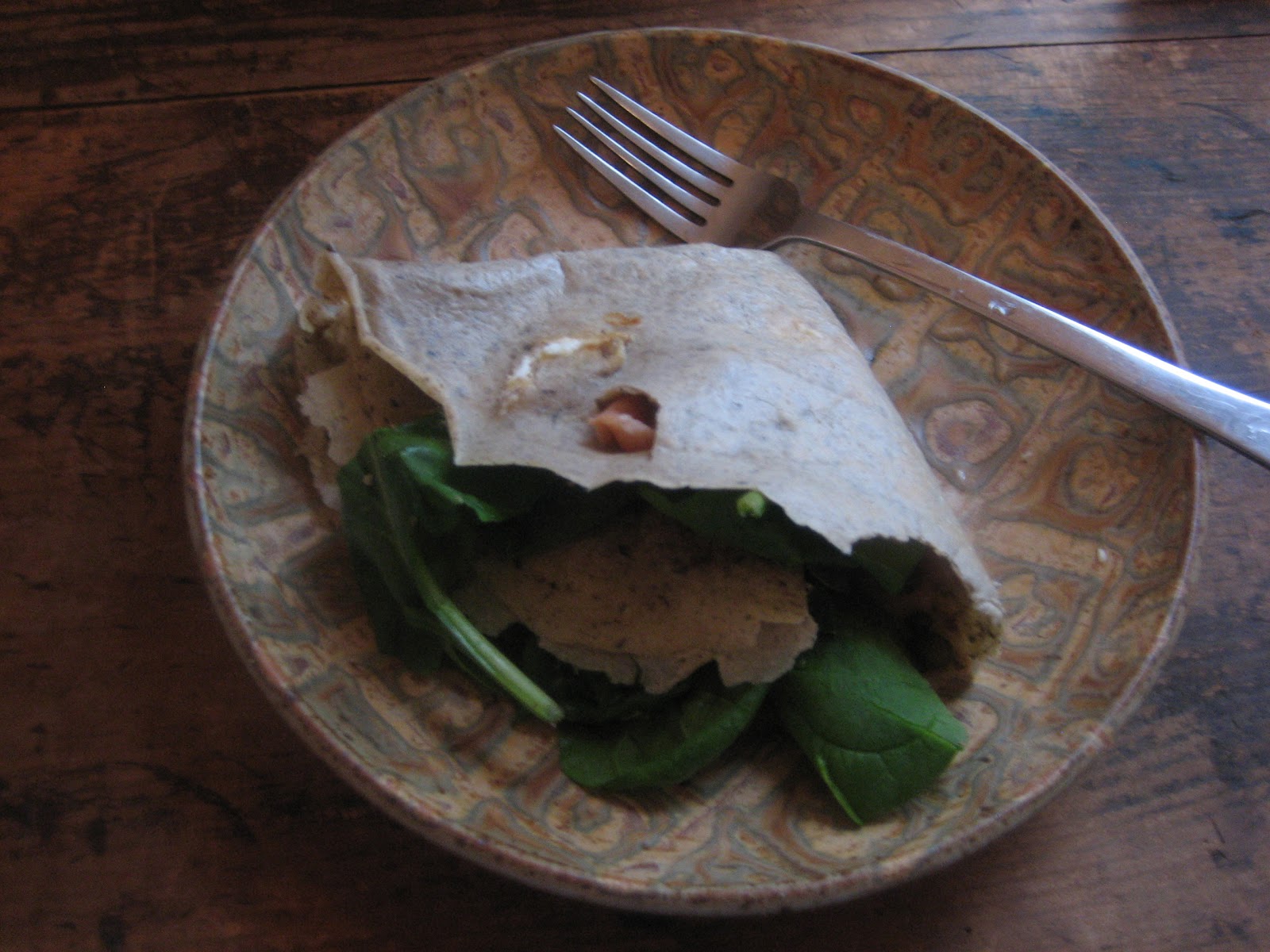
So, I’m offering to you today, this post; my floor chicken, as it were—not particularly elegant, but done all the same.


Day-Off Brunch: smoked salmon, brie, fresh asparagus and spinach, savory, buckwheat crêpes. Crêpe recipe still being perfected, but the test batches are pretty happy mistakes.

Thursday, February 14, 2013

Better breakfast redux

Ok, new plan. Studiously plow through several hours of GRE studying in the evening, hoping desperately to cultivate an innate predilection for predicates, and just when you think unconsciousness is inevitable, mix up a batch of pancake batter to be refrigerated overnight and then doled out onto a warming skillet for several, consecutive, mornings to come. Assembling that bowl of cereal now takes just as much time as portioning out the perfect pancake.

Quick and hearty pancakes for days to come
Makes about six 5-6” cakes
(or enough batter for breakfast for one for several mornings)

Ingredients:
1/2 cup white whole wheat flour (I like King Arthur best)
1/4 cup buckwheat flour
1 1/2 tbs sugar
2 tsp baking powder
1/2 tsp salt
3/4 hemp milk (or any milk will do)
1 egg
1/2 tsp vanilla extract

  1. Whisk together all the dry ingredients (flour, sugar, baking powder, salt)
  2. In a separate bowl, combine all the wet ingredients (milk, egg, vanilla)
  3. Mix all the ingredients together gently but quickly, just until combined (lumps are ok, and preferable to the abundance of gluten produced by over mixing).
  4. Refrigerate the batter to be used for quick and delicious breakfasts throughout the week, or fire up the stove immediately.
  5. Use a 1/4 cup measuring scoop to ladle out perfectly portioned pancakes onto a hot, nonstick or lightly greased griddle or skillet. Cook until an even golden on both sides.
Top the cakes with syrup, fruit, or even a fried egg. My favorite morning treat is a buckwheat cake spread with nonfat, plain Greek yogurt, quick poached wild blueberries, and drizzled with honey.    


Thursday, February 7, 2013

I'll eat breakfast when I'm retired


Two weeks ago I devoted myself to a little project—a better breakfast—that I would take time and care to craft and consume slowly, in a stationary manner, and then document on this blog. I met my goal with four consecutive, delicious, meticulous breakfasts and posts to catalog them. And you know what happened? Nothing else got done. Zilch. I mean not a damn thing, and I’ve spent this week trying to catch up as a result. There are taxes and bills overcrowding my desk, laundry that has not been washed in an unspeakable amount of time, food articles that have still yet to be fully formed and pitched, tentative vacation plans put on the figurative back burner, and GRE vocabulary that is most sorely neglected. Just look at the inchoate language used thus far in this post! How will I ever expand my use of predicates and pronouns and rather obscure adjectives if I continue to utilize only my currently pedestrian (according to GRE standards) grasp of the English language; sacrificing rhetoric advancement for a more dignified breakfast ensemble? Milk and cereal it is.

This morning I threw a slice of whole wheat bread into the toaster, turned on the iron to press my chef’s coat, and charged into the bathroom to finish blow-drying my hair. We’re lucky I didn’t blow a fuse. By the time I heard the telltale kachung of the pop-up, I could already smell the toast burning, the uneven edges of a scantily cut piece of bread singed and curling at its thinnest corner. I inhaled deeply the scent of carbonized crumbs and continued to press my uniform—ah, I thought, the sweet smell of productivity.

I am working on a new project, however, it’s called a better lunch on the go. I’m starting by dredging up an old classic: the sandwich.


Today’s lunch: roasted eggplant and tempeh on whole wheat toast with fresh basil and arugula, a smear of ricotta cheese, a sprinkling of dried rosemary, ground sea salt to taste, and a side of pretty plump cherry tomatoes all stuffed in a tupperware and toted to work.

Friday, January 25, 2013

Foodlore, or, Shall I talk at you while you eat?


For Christmas, my parents gave me Harold McGee’s On Food and Cooking: The Science and Lore of the Kitchen, which has instantly become one of my most beloved books, combining all that I love most—food science, history, and folklore—within a singular binding. Everything that I eat must now be cross-referenced with this tome to eke out the full socio-nutritional value from every bite. From last night, for example…

The original English word for a fermented barley drink was not beer, but ale. It apparently derives from the effects of alcohol; the Indo-European root of ale had to do with intoxication, magic, and sorcery, and may be related to a root meaning “to wander, to be in exile.”
-On Food and Cooking, page 742
A beer has never before tasted so bittersweet.

During my brief break at home over the holidays, my parents were no doubt equally thrilled by my similar investigation of all our shared meals and ingredients. My mother smiled along kindly to the morning’s gluten/pancake lecture that included a visual (page 522) from the book demonstrating elongated gluten molecule chains formed during mechanical action (i.e. stirring, mixing, or kneading) and the suggestion that scantly stirred batter would produce fluffier cakes. In reality, this gluten conversation was probably only a fleeting moment, but, entirely high on my newfound plethora of food related knowledge of both modern and ancient origin, in my head the exchange was much more epic: put down that whisk, good women. Thou doth stir too much!

My father, opening the freezer a bit later in the day, made the mistake of wondering, out loud, what it is, exactly, that prevents ice cream from freezing into a solid, crystallized lump. Carrageenan! I shouted immediately in return, running frantically for my book to further discuss the polymer (page 805). You would know, my father exhaled, and then exited stage right, proceeding to eat his ice cream in the other room where I would not hover over the bowl and pronounce further nutritive and chemical properties of his cherry-chocolate-chip afternoon snack.

Thus, by the time I’d barged into the living room that evening, planted myself firmly between the television and coffee table to discuss the ideal temperature at which popcorn pops, paired with a bit of prose by Henry David Thoreau declaring popcorn the perfect winter flower (page 480), it’s no surprise that my parents merely nodded and leaned a few inches to the left, inevitably straining to see the movie now thoroughly obscured by my right hip.

I’m fortunate enough to work with coworkers who listen to my never-ending food babble, and to live with two delightful roommates who entertain my nightly harangues on food culture and science with genuine, or very convincingly feigned, interest. One roommate, a medical researcher, usually sends me informative links and websites later in the evening post dinner discussion. One evening’s dialogue about the correlation between gut flora and inherent mood generated a link to a micro biome mini-series (I’m serious about that gut flora thing, by the way. Eat more yogurt).

So, today I’d like to thank all my friends and roommates, and family who have eaten a lot of sample recipes, both the successes and the flops, endured long conversations and many questions (in person, via telephone, and email) about future food careers, and who have listened, in general, to a lot of food facts and foodlore, and maybe even encouraged it, and who have been beautifully encouraging too throughout this past year as I struggle to find the right course of food study for me, and stare down the GREs and some grueling science prerequisites in the process.

My parents in particular deserve a huge thank you. Despite my proclivity for constant food lecturing, I’m still invited home for dinner.


Breakfast today: ode to fruits, nuts, and seeds brown rice porridge—leftover brown rice warmed with a little milk (ideally almond, hazelnut, or hemp milk to capture a little extra, nutty, flavor), chopped, dried, unsulfured apricots, raw almonds, umeboshi plum, and a scattering of chia seeds.

Thursday, January 24, 2013

Cheese please, and some prose


Yesterday, I was thrilled to see an article in the New York Times that links food and words in perfect harmony, specifically cheese and prose. This particular article talks about so much at once—the beauty in the art of making cheese, the profound deliciousness and stark contrast between the products, and the ever-present competition felt by anyone who has ever attempted to make a creative passion into a career. Well worth a read. Highlights from the article include stunning (if not a bit moldy) images, talk of sex, drugs, and fermentation, and this insightful description of an Andante Dairy Nocturne:

Icelandic ponies. Japanese cats on the Internet. Yawning puppies. Toddlers who give each other hugs. Goats climbing all over everything. Pink and green macaroons. Red pandas. Sparkly nail polish. Do you get where I’m going? Cute things. This cheese is so perfect and cute and delicious you just want to marry it. Or buy one and eat it.
-Jeff Gordinier for the New York Times quoting a description from the Bedford Cheese Shop


Breakfast today: fried egg atop sautéed shiitake mushrooms, arugula, and fresh bean sprouts. Then, topped with a quick, mixed-up miso, sesame, soy sauce.


To make it your own, simply sauté whatever vegetables you like most, or those that you have kicking around the refrigerator (something green and leafy paired with something of the fungal or root variety is my favorite). Add in some fresh sprouts or more leafy things for a little crunch, and finish with a fried egg, yolk still runny, please. Try mixing together any of these wonderful condiments if you’re craving a little extra dressing: soy sauce, sesame oil, brown rice vinegar, white miso paste, honey, sriracha. 

Wednesday, January 23, 2013

A better breakfast


I always burn the first rice cake. It’s a trait I inherited from my mother. We both buy the breakfast cakes in multiples, knowing that one package is not enough for the week because at least half the servings will end up wasted, overdone and uneaten. In fact, the package label advises against toasting—the rice cake is to be eaten as is; its structure is much too delicate for applied heat. Still, we toast.

Here’s the thing about rice cakes: there is something sterile about them. They’re not sweet, or particularly salty. Unless flavored, they are a singular umami. Unlike other breakfast carbohydrates, the rice cake has an unforgiving harshness, a jagged crunch that I find satisfying in the mornings.

The rice cake has no emotion. It lacks the softness and comfort of toast, and it has no guts, no doughy interior like the bagel. The nooks and crannies of the rice cake were not so sweetly named as those of the English Muffin. I’m not sure they even have a title, the gaps are just airy, empty pockets between the bonded grains.

Butter is useless on a rice cake; it simply melts and pools off the sides. A rice cake requires a spread of more substance—jam, or peanut butter. I like to habitually over-toast my morning cake and layer it with cream cheese.

The rice cake is not a patient food. You cannot put in the oven and expect it to wait for you and thus it is an unforgiving breakfast predilection for individuals who continue to toast it against better judgment. My mother sets the timer on the toaster, the knob dialed all the way to the left, pointing at light, but still the cake burns. She’ll stand before the open toaster oven, singed cake still steaming, and flap her arms momentarily in a small gesture of exasperation, looking like a disrupted bird—mildly ruffled but not distressed enough to take flight. The rice cake will be tossed into the sink to cool before being piled on top of the compost heap, awaiting transport from kitchen counter to outside garden (my most dreaded chore as a child—schlepping counter compost deposits outdoors) where it will eventually melt back into the earth. A second rice cake is then placed into the toaster oven and watched, diligently, for the first signs of telltale browning around the edges. We never burn the second cake—a single sacrifice is sufficient for the morning ritual.

Dinner was the meal my family ate together most often when I still lived at home. I realize now, however, that our distinct breakfast rituals have had an equal, lasting impact on me. If dinner was an orchestrated meal, breakfast was a free for all, revealing individual preferences, and inherent personalities. My father usually arrives at the table first to claim most of the morning news. He layers his breakfast cereals—shredded wheat, granola, flakes—as if planning an architectural undertaking, layering grains and milk in a decided pattern, building a foundation for the day.

My mother rarely commits herself fully to the breakfast table, alternating between sips of coffee and gathering last minute supplies before heading off to work. Often the coffee is reserved in a stainless steel thermos to be consumed on the go, and is then forgotten on the kitchen counter for the remainder of the day.

I too find it hard to sit still so early in the morning. I leave my apartment still chewing the remnants of a scant breakfast like some hasty ruminant, or toting bread, or rice cakes with me for toasting on the job. At the small bed and breakfast where I worked during the summers on Cape Cod, I continually unnerved my boss when my forgotten morning rice cake launched, flaming, from the pop-up toaster on several occasions. I topped it with strawberry jam and ate it anyway before heading off to scrub toilets and make beds for the majority of the afternoon.

I started a new project recently, a campaign really, for better breakfast—to take a little extra time each morning to converse with my stomach; to ask it what it would like to eat instead of stuffing it with carbs on the go, and to enjoy tea, and toast, and a few minutes of reading before picking up the true pace of my day.

I was fortunate enough to be awarded the Julia Child Foundation’s Teaching Assistanceship at Boston University for this semester. I get to return the BU kitchen now, 4 days a week, where I prep ingredients for visiting chefs’ demos, and work with new students, and offer, gentle, I hope, guidance for how to better hold a knife. I spend the day inventorying and rearranging, and learning even more about food. And that often leaves, as usual, little time to enjoy it in a leisurely, unencumbered, manner. It’s back to stand-eating several meals a day, I’m afraid, in the name of gastronomic education. The least I can do is reclaim the calm of breakfast for myself.


Today’s breakfast: homemade whole wheat toast with a smear of butter, a fried egg on arugula (yolk still deliciously molten), and a cut up pear, bosc if you’re wondering. A better start than yesterday’s omelet debacle; this signals, I think, good things for the day.


Tuesday, January 22, 2013

A good omelet takes panache


If good scrambled eggs demand patience, a good omelet takes panache…Escoffier described the omelet as scrambled eggs held together in a coagulated envelope, a skin of egg heated past the moist, tender stage to the dry and tough, so that is has the strength to contain and shape the rest (91).

-from On Food and Cooking by Harold McGee.

Sometimes you go to four months of culinary school, wake up with a head cold, and produce a breakfast omelet that still looks like this…


But, then, there is still lunch to look forward to.

Friday, January 4, 2013

Savory

For Christmas I asked for salt--pink, grey, fleur de sel--and then, thinking it over further, I requested some pepper too.

I have a soft-spot for a good salt and pepper set--an enduring partnership built on complimentary good taste. It's romantic.


Happy New Year.

Tuesday, December 18, 2012

Linger longer, lunch

For the first time in four months, I did something unusual today--I made made myself lunch, and then ate it, calmly, sitting down.

I've been a bit openly harsh on my weekly schedule and eating routines and it's not because I'm not entirely thankful for all that I've been able to learn and achieve in the past few months. Still, so stuffed each day with a mandated recipe in class, or pathetic leftovers that I'd toted to work to eat standing up, huddled behind the swinging kitchen door, a meal made just for me, and which I could eat, savor even, at whatever prolonged pace I chose, seemed like something extra special.

I thought going to culinary school would teach me more about how to write a recipe precisely. Turns out just the opposite is true, and that really, I had it right all along. I was told, repeatedly, that a recipe is just guidelines and not the final ruling--it's ok, encouraged even, to change some ingredients and proportions. You can't cook by the recipe alone and expect a great meal; you have to cook a bit from your head, and your heart, reasoning out what proportions will actually make for the best meal, and what ingredients will become most harmonious. The truth is, chefs, by nature, are just notoriously bad at writing recipes. Because they don't frequently use them. The number of times that we actually followed a chef's recipe, verbatim, in class, I can count on one hand. To follow directions makes you a good student; to develop a sense of proportion, and rhythm, and taste, makes you a good cook. So, I'm asking that you humor my often imperfect recipe measurements because even if your fistful of arugula is different from my own, chances are, it's just the perfect size for your meal.

Israeli Couscous with roasted squash, pears, and fresh arugula

Serves 1

Ingredients:
1/4 cup dry Israeli couscous
1/2 bosc pear, diced (or 1 whole pear, and just eat 1/2 of it for your pre-lunch snack, like I do)
2 cups butternut squash, peeled and diced
a few tablespoons of pepitas, raw (or another seed/nut if you prefer)
olive oil for the pan
salt and pepper and cinnamon to taste
a huge fistful of fresh baby arugula

1. Cook the couscous according to the package directions. I like to use a 3:1 water to couscous ratio.
2. Spread the squash on a sheet pan, toss with olive oil, salt and pepper, and cinnamon, and put into a 450 F oven for about 30 minutes, or until tender and lightly browned. When the squash is almost done, add the pear and the pepitas to the pan. Roast until the pear just softens and the pepitas are crisp, but not browned.
3. Toss the arugula with all of the cooked ingredients, add any more olive oil and salt and pepper to taste, and serve hot.
4. Savor your meal for as long as you'd like. No one is going to rush you, today.


Stubborn

Occasionally, we bump up against one of our own, lesser known, personality traits in an unflattering manner. For instance, it was not until I examined the already stuffed food processor bowl--brimming with butter and sugar and almonds too--, knew that it had entirely reached capacity, and cracked in the second egg anyway, that I understood that, perhaps, I'm more stubborn than I think.

I'm going to declare this a good sort of stubbornness, the kind that lets you stick to your conviction and get stuff done. But, then again, it is also the kind that spews frangipane tart filling all over your counter because you're rounding the corner on the final hour for final project recipe testing and you'll be damned if you're going to dirty another mixing bowl.

Let's declare this sort of stubbornness, then, as the sort that affords you the ability to assess both the situation at hand, and the aftermath, and the gumption to proceed anyway, even against better odds. Some mistakes, I guess, just have to be made. 

Sunday, November 18, 2012

Overfed, under pressure


Somewhere in the middle of a European history lesson, my seventh grade teacher pronounced, “the definition of insanity is repeating the same behavior and expecting different results.” I believe this quote is most often, but unreliably, credited to Albert Einstein, among other significant historical figures. The point is, I can’t tell you much about the Enlightenment, or the French Revolution, or the dates of anything really significant in European history for that matter, but this sentiment—the defining of insane behavior through consistent, repeated action—somehow lodged in my mind, permanently. And now, I’m actively living out that which I have been warned against, moving through each day in a repetitive cycle that aspires to a change that continually fails to materialize. I complete rigorous coursework to collect collegiate degrees in the liberal arts without benefit of employment, I email resumes and cover letters into a virtual abyss without positive response, and I exercise with a regimented, persistent, and absolutely ridiculous fervor without altering my body in any visually significant way. Still, I repeat, and, by definition, the cyclical consistency of these unfulfilled actions means that I am now, indeed, twenty-five years old and teetering at the edge of a particular form of insanity.

I haul my body from bed at 5am every morning, I put on something moderately spandexy in the dark of my room (apparently there is an unspoken fashion code at most modern exercise facilities), and shuffle the six blocks to the gym. I get on the treadmill and begin, running reliably for an hour four days a week, most mornings sprinting past five full miles in fifty minutes. But then, I wonder, what have I really accomplished? I’ve heard claims of a runner’s high, but I’m just flailing, it seems, and ungracefully so, towards an undefined finish line. All calories burned will be replenished, inevitably, when my cooking instructor for the day asks the class to taste test the blueberry and pumpkin pies simultaneously along with the almond tart and mushroom quiche. I put fork to plate, enjoying the culinary lesson but knowing full well that I’ll be right back here the next morning, pounding the proverbial pavement on a never ending rubber belt, and praying hard for gustatory relief.

Sometimes, I have enough energy to ponder something other than my asthmatic, labored breath as I exercise, and so I look to the left where the woman next to me seems to be jogging at the same cadence on her treadmill but with half the effort, and half the body weight bobbing along with each foot stroke too. The treadmill is a simultaneously genius and moronic invention—eureka! A means of sprinting forever without every running out of space. Or, a way to run forever without ever gaining any ground—a mad dash to nowhere. It’s too early in my day when, each morning, I begin to wonder if I’m running towards or away from something, and then if it even matters as long as the raspberry tart I’ll make in class later eventually slides off my thighs where the rest of the test-tasted baked goods have set up camp for the semester. Sometimes I realize I’ve been running with my mouth open like a Labrador retriever, and I slap it shut quickly, attempting to breath less audibly through my nose, and plow ahead, jogging straight at Bobby Flay who is stuffing ground-up sausage into a chicken on national television. I wonder what kind of minced meat I will stuff up the rump of another animal carcass in class today, and then consume it in the name of learning, and then get up too early the next morning to try to negate such gluttonous, carnivorous, calories by running mindless circles in a never ending loop.

Today I cycled twenty-five miles on the stationary bike during an insanely early Spin class. What sort of accomplishment is such a chunk of distanceless miles? “We’re nearly at the top of this long hill,” the Spin instructor says, and I’m huffing and puffing, sweating shamefully, and wishing so hard for the extra culinary class calories to evaporate that I’m actually willing to participate in this little scenery charade. “The next hill’s even bigger,” she belabors, “but we’ll make it, ladies!” Considering the bike I’m pedaling is bolted to the floor, I’m betting that indeed, yes, we will, but then again that’s not really the issue. The point is that I’m cycling pretty hard at a fictional trajectory—working fervently and going nowhere, and doing so on a daily basis.

Roughly two years ago I was hit by a car while biking to work. I struggled for months with what I can only describe as indistinct, posttraumatic insanity. By definition, if repeating the same action will conjure the same results, then it seemed that the only way to evade repeated disaster was to alter certain behaviors, even those that seemed insignificant. I curled my hair the morning of the crash, so I left it straight each morning after that. I had toast before I left on bike accident day; I started eating morning yogurt. I couldn’t reason on the ratio of toast filled days that hadn’t resulted in a near death collision, only the one, scary, day seemed to matter, and I would do whatever possible not to repeat it. So I replaced all of my insignificant morning rituals with altered actions. I got dressed in a different pattern, praying that my boyfriend at the time wouldn’t wake up to see me suiting up for work, sneakers first. Yes, I felt like an idiot standing in front of the closet mirror in a bra and underwear with tennis shoes already laced onto my feet, but I also remembered a specific day in which I’d put on clothes before socks and the results had been life shaking. Still, had I been caught, I would have been without reasonable explanation—how do you explain, rationally, to the person that you love, that if you put on your pants before your shoes, you’ll probably die?

Food and science are the exceptions to the insanity rule. Experiments are repeated again and again to prove that the results are consistent. This action of repetition with the expectation of sameness is considered sound, scientific practice. Yet, many times, the end results are distinct. One rat was miraculously cured of disease, but the next one kicked the bucket. The test must be repeated before any conclusive theories can be proposed. The same principle holds for cooking. I can repeat a recipe using the same ingredients, measurements, and methods, and still the second batch of risotto doesn’t match the first. I currently have two loaves of pumpkin bread stuffed into the freezer, both made with identical proportions, and in what I thought were identical environmental conditions. While neither is ideally the fluffy texture one might hope for in toast, the first loaf is merely a little extra dense while the other is collapsed so tightly onto itself that it more likely resembles a weapon of assault than breakfast bread. This constant inconsistency is why my actual recipes have become so few and far between on this blog—consecutive tests have proved distinctly inconclusive, and I lack the free time to continually retest.

I’m amazed by the contradiction of this dense bread—if insanity is repeating the same behavior and anticipating different results, then what is repeating the same behavior and expecting identical outcomes? Sound judgment seems like a reasonable answer given the equation at hand. So I’m adding the yeast, and kneading the dough furiously, and staring at two identical loaves that are rising at drastically different paces. Then I realize that I’m spending the majority of my single day off from work and school quite literally watching the varying fermentation rates of yeast. And I’m wishing so hard that the loaves will somehow, eventually, rise to my standards.


Illustration by Caitlin Sundby.

Monday, November 5, 2012

Vegetarian insomnia

Sometimes, when the seasons change, you can't sleep, and you have slightly obsessive compulsive tendencies, so you practice your knife skills and bake vegetables in geometric patterns at 5am. Sweet potato, eggplant, delicata squash, olive oil, and a little salt and pepper makes for the perfect, roasted, lunch.